Unfortunately, all three pools were in the open, and bathers were required to wear swimsuits. Since I didn’t have a swimsuit, I had to buy one. And the only kind for sale was of the one-size-fits-all variety. No problem, I thought, and went to change. Apparently I had put on some weight, and the seams strained to contain my bulk. As I emerged, a pair of Chinese bathers took one look and said to each other, “Wow, look at that guy. He’s so fat.” I was in shock. I had always considered myself a modest-sized individual, and now I was having trouble wearing the one-size-fits-all swimsuit. I remembered weighing myself a week earlier in Hong Kong. The little card that had fallen out of the slot above the scale had said 190 pounds. Now I was being confronted by the hard truth of what 190 pounds meant for someone five feet seven inches tall. I slipped into the pool, hid beneath the steaming water, and considered my options. Obviously, I was living too large. As a feeble gesture, I decided that for the rest of this trip I was going to limit myself to one beer every other day. I had to do something.
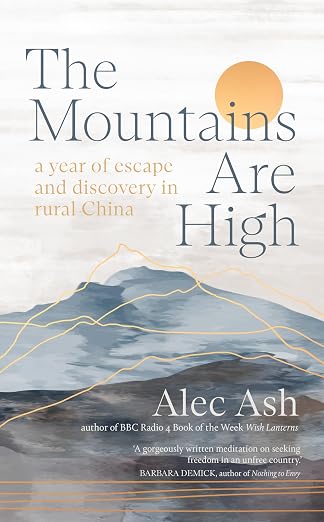
The high refers to those who are like him, coming from elsewhere in China for an extended break and are high from either drug or some other form of escapism. He took drugs too (weed at first, then acid). After tripping on acid he decided that he found his faith.
I don’t like the book for the suggestion that taking drugs as a short cut to finding faith – he suddenly found his faith after an acid trip. For that it is a thumbs down and after the book, I don’t like the guy enough to read another of his book. In the 1 year he spent in beautiful Dali, with all that nature and history and all he could think of naming is a pun on drug taking?
This format isn’t meant to compare these books – just listing what I’ve read in a more condensed way.
There is so much love that Peter Goullart has for Lijiang. I feel disappointed to discover I can’t buy his other writings – they are out of print. When I was in Yunnan, I love the touristy version of it. Yet, when we were there on holiday, there is this undercurrent of too good to be true. Peter Goullart does open with the touristy version of Yunnan in the 40s – enchanting, humourous, peaceful and mostly locked away. He also shared the real lived version of it. Opium, petty thievery, crazy aggressive tribes, and the Naxi community around him. He was sympathetic to the people in the area, generous and willing to humble himself to make friends in the community. He could not be a better official for Yunnan branch of the Chinese Industrial Cooperatives for one main reason – he was willing to hike up inaccessible places, learn so many languages and was honest and transparent. He is literally the kind of just, fair and open magistrate that C-Dramas portray. Even with the not so great experiences (from the minor annoyances to outright close to death) he has with the tribes, he remained open and magnanimous.
I was surprised to find out he wrote it in Singapore and found publishers in Singapore. That’s amazing. It’s so sad though I can’t find his books in print.
It was strange to me that this was sold so widely and won lots of accolades. I felt the author replaced research with fiction and that was about it.
I finished the book and felt it was totally alien as if a far away westerner writing about a tribe in China. The more believable aspects of the portions was when all the characters moved to America. All of a sudden, they felt at home. Not lost, trying to explain and understand a culture they didn’t belong. I had a hard time trying to figure it out what made this book strange for me. It was extremely well researched but something was not tight about the story.
Superstitions and cultural norms and taboos are the first ways that humans collectively reduce their risk of death, of man made or natural disasters as they go about their day to day life. Their village has a ruma (spirit priest) and a nima (shaman) – this indicates that their beliefs are extremey tight as a norm. Their norm is also intense pattern identification from dreams as an indicator of potential or emerging risks. Even if one person in that village is educated, that one person will live life very close to the cultural norms even though education explained those beliefs as superstition. 山高皇帝远 -being “very far away from the emperor”, being in the hills, change and the Cultural Revolution didn’t make a huge difference. Change was slow as is expected in this place where the teacher was exiled.
In this context, every tribe person would adhere closely to these norms. There will not be accidents such as San Pa hitting the spirit gate. In these cultures, baby care will be more extreme because not only you will need to care for the child physically but also protect it spiritually. Li Yan’s mom will not leave the baby alive because bad things will happen to her family and the child as well. As a culture and a midwife who has no qualms getting the man of the family to kill two newborns (rejects), to leave a reject newborn is to subject it to something worse than death. As a mom who had given birth to a fatherless child, regardless of her maternal instincts she would also follow those practices. It would be worse for her not to. The logical story would be the sheer imagined terror of unleashing a defenseless child against spirits who will attack it and cast bad omens and actually do bad things through the baby, like a poltergeist. (See this detail explanation by Ruijing Wang that I found – “Ritual Care: How the Akha Take Care of Their Small Kids?”)
It is also unexpected that an educated person will abandon their norms immediately after moving to a different country. My observation is that the norms are best preserved by migrants. They live as though frozen in time. They carry on their normal tasks while internally, they are still there with their grandparents and parents in the countryside or in their home country. Habits, norms in their home country has changed significantly but these are not transmitted to the migrants. So they freeze what they know and carry them out in their new home. So when moved to America, when the American white people’s prudish habits of stating that they don’t go out and just eat and have intercourse, it was jarring. Talking about a one bedroom bungalow and describing it as cozy and perfect for 2 persons is crazy. A 4 bedroom house (“Spanish styled”) is grand and extremely luxurious. Knowing that it is styled in Spanish ways and she has a room that sounds like a writer’s room, is off the charts nuts in terms of luxury. 不上头才怪!
So when she suddenly behaves in America as if familiar with the comfort, taking on strange habits of stating intercourse (almost like those Nanyang artist besotted with topless Bali ladies) it sounds correct. Like she is an American – never was Ahka at all. The odd device of doctors writing long letters to new parents of the baby, I could actually accept it. Very rich people do have doctors who are on call and has wonderful bedside manners. Not having one is usual means not wealthy enough. It is odd though to be so descriptive. Ha ha.


 headbirth.com