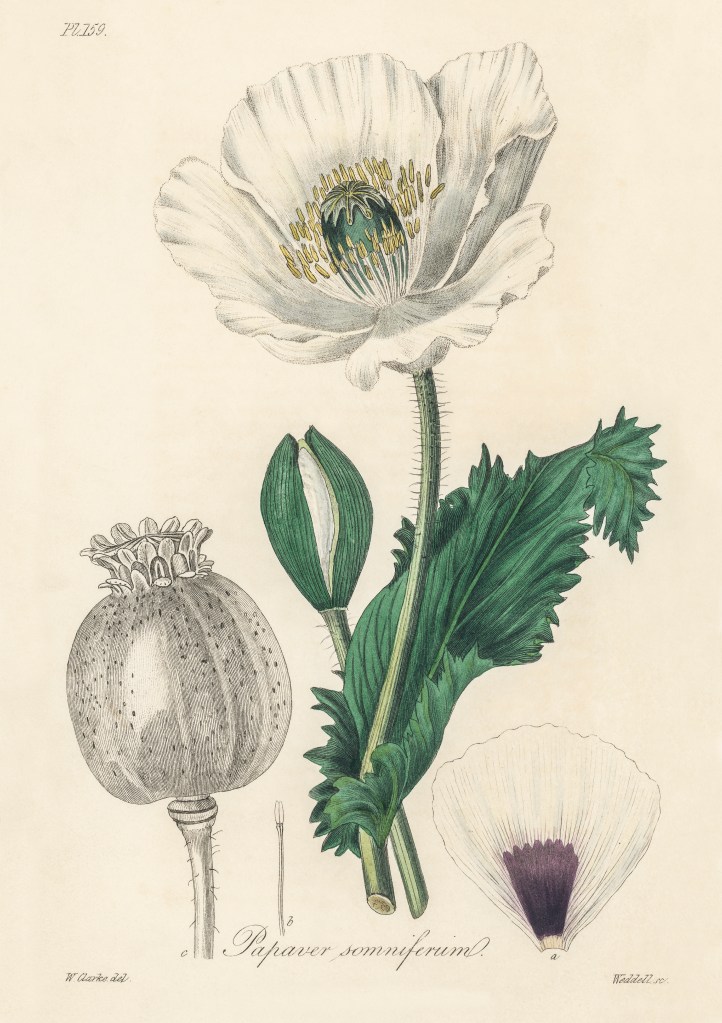
I have not much idea about Chinese History and had to google timelines while reading the earlier article on tax revenues in Qing dynasty. One thing I was surprised to find out was in 1729, Yong Zheng had already banned opium selling and its use. There was a stricter ban in 1799 again. Opium had become a problem but government officials didn’t want a strict enforcement because that will reduce the amount of tax that can be collected. Opium was a very profitable business. First, it was an easy crop and is grown around Yunnan area. The original use was medicinal and the smoking of opium was mixed with tobacco and then just opium. The use was mainly by the wealthy but when the lower grade opiums became accessible to middle and lower income classes. In Peter Goullart’s Forgotten Kingdom, he said that most around Yunnan smoked opium. It was a part of leisure activity. Later, when the communist’s Red Army came along, even when opium was strictly banned, there were late night executive meetings that came with food, drinks and smoking to accompany the discussions.
There are some historians who viewed that the war was accidental and Opium trade wasn’t a big thing for Britain. It was just some merchants trading.
Harry Gelber wrote: Only in September did London became alarmed, with the arrival of a Canton dispatch of May 29 relating China’s military threats against defenseless British civilians….For British politics the issue ceased to be opium – about which many people sympathized with China – and became the fate of not just opium traders but innocent men, women and children threatened by armed Chinese soldiers.
By then opium trade was banned. So these women and children who were smuggling opium being considered innocent and threatened is a spin by ministers? So a key reason why sending military force was necessary was because the merchants were promised compensation of the value of the opium seized. Britain did not have the 2 million pounds. Military action was suggested, wrote Harry Gelber.
Not everyone agreed. It was after all a drug that they were selling.
The fiercest thrusts came from young William Gladstone, destined to become Prime Minister decades later. “A war more unjust in its origins,” he declared “a war more calculated in its progress to cover this country with permanent disgrace, I do not know and have not read of.” Palmerston’s response was masterful. It was obviously entirely China’s business to decide what should be imported into China, and to supervise and control China’s coasts. But as it was, the actions of the Chinese Commissioner had been “unjust and no better than robbery.” Indeed, a joint British, American and French naval force should in future be stationed on the China coast to look after Western interests. Though a British military force was now being sent, a demonstration would probably be enough to have British grievances met without further action.
Now if we think of this as a spin where the actual money was the real root of the problem, is opening more ports a real reason? If the Chinese did not want anything else from Britain – there was already trade in Canton and China was selling Tea, Porcelain and Silk – how would opening up more ports, expand the products that Britain could sell to China when China had nothing Britain had other than Opium? Who really is the merchant(s) who has these seized and egging Britain to go to war? Hans Derks said it was William Jardin. (Chapter 2, pp 13).
Hans Deck was harsh, pointing the blame squarely on Britain as the aggressor. The funny thing is few actual Chinese didn’t think Britain was an aggressor. Few articles I’ve read mostly believed Britain had reasons to go to war. However, I can understand that with the Queen as the Head of the Anglican church it would be very strange for Britain to openly protect the opium trade. Surely some other reason need to be used and not an addictive drug. Hans Derks pointed out that Dutch started the profitable trade of opium into the Asian trade route. British copied the Dutch’s methods and became richer. Britain was indifferent to the morals of selling opium. While the Christians disagreed with this trade and sent letters back to England, they eventually for many reasons supported its legalisation, wrote Huang Yi.
Now is it true that Britain was reliant on the Opium trade for tax revenue? A more measure statement would be that it trades in opium as well as other goods. But a clue is in the earlier article that I’m reading: “Money, Power, and the State: The Originals of the Military Fiscal State in Modern China” written by Stephen R. Haley in Journal of the Economic and Social History of the Orient 56 (2013) pp 392-432
So the key premise in that research is that because of incredible need for money by the government, the officials had to devise new ways to increase taxes. This new ways were devised by the smaller officials and then eventually agreed by use of the court. Qing government needed money because of military and defense needs. There were not just uprisings but also the need to defend the realm from foreigners, paying the unequal treaties. When Taiping Rebellion occurred, the foreign forces (including Britain) thought that if the Taiping rebels won, then they won’t have free access to Chinese ports and the Opium trade will also be gone. With this in mind, the foreigners provided weapons to help Qing to eventually suppress the rebels.
I had finished Forgotten Kingdom and feeling a bit of withdrawal so I went to library hoping for similar travel books. With all these opium stories in my mind, just walking by the aisle, Gabrielle Paluch’s The Opium Queen leaped at me. I was totally shocked by the contents.
Since my first day of skepticism in the publisher’s office at the Myanmar Times, I had learned one of the first eyebrow-raising failures of covert US foreign policy executed by the newly formed CIA during the Cold War involved arming and financing anti-communist Chinese troops in exchange for opium, firmly lodging them in Burmese borderlands as a military threat for decades.
The book had lots of interviews with the people around the lady Olive Yang. I was shocked by the interviews, esp this with Francis Yang, a younger brother of Olive Yang.
“Did Olive ever talk about trading opium with the CIA…”
“You know people love to talk, even I want to know how Olive always got away with everything,” Francis said, explaining that Olive always seemed to find a way around the rules. “We just thought those weapons came from General Chennault’s men. We didn’t realize they were CIA until afterwards.”
“After what?” I asked.
“After we were expelled,” Francis said. “You know all this CIA, DEA, I used to think they were the good guys-they were just as corrupt as the rest of them. They were all working together. As soon as Jimmy needed then, they didn’t want to know him.”
You just have to read the book to know the cast of characters. I could not believe what I read. I had to poke around more. INTELLIGENCE AUTHORIZATION ACT FOR FISCAL YEAR 1999 (House of Representatives – May 07, 1998) A Tangled Web: A History of CIA Complicity in Drug International Trafficking had a long history all written out. America through CIA in its attempts to limit the spread of communism, supported the drug trade across the world. Japan’s yakuza became a major source of methamphetamine in Hawaii. In Taiwan, the CIA provides arms, ammunition and other supplies to the KMT. KMT settles in TW and expands opium production. By 1972, the KMT controls 80 percent of the Golden Triangle’s opium trade. During Vietnam War, CIA renews old and cultivates new relations with Laotian, Burmese and Thai drug merchants, as well as corrupt military and political leaders in Southeast Asia. Heroin production increases dramatically. And so on. (Heroin is also made using opium as a source.) Looking around for more validation, I found the wiki for the book The Politics of Heroin written by Alfred W. McCoy with Cathleen B. Read and Leonard P. Adams confirming CIA’s involvement even if CIA did not traffick drugs. It reminded me of how the British spin this uncomfortable fact that they were selling drugs to China ie, this was morally wrong to protection of British interests.
The story is now changed. But when the narcotics flowed into Vietnam during the war and Americans soldiers became addicted, suddenly America decided to declare a War On Drugs while CIA continued to support the drug trade through protection of key drug lords. Now America leads Anti Bribery and Corruption, Anti Terrorists and Anti Money Laundering and Trafficking. How much of this is to spin another story for it’s own citizens to disguise some facts not widely discussed?
 headbirth.com