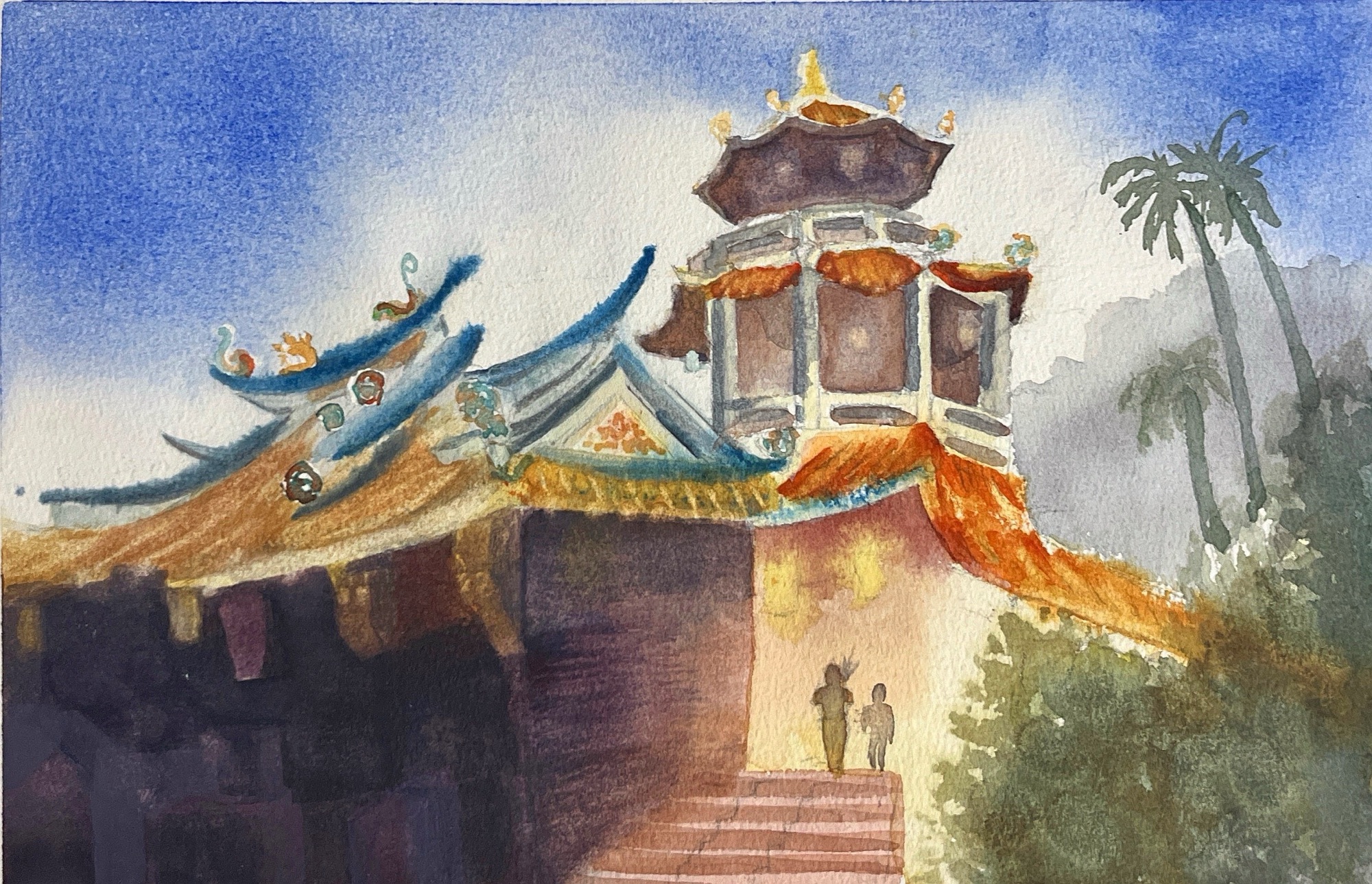
Category: Drawing
-
Elsewhere: On Hopper
The Story Behind Edward Hopper’s Iconic Painting, “Nighthawks”
The article talked about the obvious loneliness of his paintings. I have two favourite paintings of his – Night Windows and Office At Night. The look of fluorescent lights and makes it real for me. I love the look of light in paintings.
I feel connected to the characters in the painting. Loneliness to me means a yearning for connection but I feel the characters in the painting emotionally complete. Night Windows reminds me of myself after a shower, picking up pyjamas to change into. Office At Night had a weird light telling me to look at the sexy lady standing at the cabinet. She also reminds me of me, the intense staring at the man at the table. Maybe the desire for most to connect is so strong that they read loneliness in the painting. I feel a little joy.
I like this quote from Hopper: “If you could say it in words, there would be no reason to paint.”
-
Watercolour Etudes: 28 Oct 2026 Basic Practice 1 分块接色法 (Colour Blocking)
📌 This is a series of posts on my art studies using Chien Chung Wei’s book Watercolour Etudes 《水彩练习曲》作者: 简忠威 #chienchungwei #简忠威 #watercolouretudes #水彩练习曲The pre-practice was unclear to me at first. I was to place blocks of colour yellow, green and blue around different areas of the paper, not touching each other. Then with darker colours (purple and brown) fill the spaces in between such that the original colours mesh with the blocks.
By the 4th time, it was less of a failure. I moved to the wine jug practice. The 1st jug I did showed some promise. By the 3rd jug, I was so pleased I called it a day when done.

-
Watercolour Etudes: 22 Oct 2026 Notes on Preface
📌 This is a series of posts on my art studies using Chien Chung Wei’s book Watercolour Etudes 《水彩练习曲》作者: 简忠威 #chienchungwei #简忠威 #watercolouretudes #水彩练习曲1The master had written (Translations mine)
如果你对前方之路的尽头感到好奇 If curious about the end of the path ahead 就把这条路走到底, 或许你会发现另一条看不见尽头的路也在吸引着你 follow it to its end, perhaps you may find another path beckoning you – one that has no end. 世上多的是风景优美的路线, There is a wealth of picturesque paths in our world 欠缺的是真心探索的意愿 Sorely lacking is the genuine desire to explore I paint out of curiosity. My motivation is to be able to figure out the magician’s tricks and re-create that in a scene. At this moment, I am not sure if I have the desire to explore the full way. I am afraid of being labelled an artist. Or a failed artist (if I don’t sell anything or win anything). It feels at the moment the label is too much for me to bear. The expectations too heavy for someone who is poor at it.
简大师 wrote in his preface explaining the benefits of copying from an artist. Right away, I felt taken care of and reassured. I felt that he truly understood me. A person who started from zero. He explained that following tutorials in painting different objects (Eg clouds) did not translate to confidence in tackling a new object (eg trees). I love the idea of following along guided by him in a series of copy works. He also said that completing this book does not a painter make – there are compositional and creativity skills that needs to be self taught.
I have been experiencing doubts if art can be self studied – mainly because I have been seeing a lot of progress and completed works that my other art friends have made under tutelage. At this moment, tuition fees spending are prioritised for my kids so my plan has always been to self study. That Master Chien laid down the next steps to learn made me feel really safe that he is hand holding me in this journey.
- This is a book bought on Temu and can be found on aliexpress. You can use the chinese text to search for the copy. This book is in Simplified Chinese. There is no English version. ↩︎
-
Art Practice 6 Oct 26

Blaming it on the boogie 
Before the dancers got on scene Painted using my Gansai Tambi in card size. I tried to follow Ian Robert’s instructions to paint only shapes and it seems that square and triangles are my favourite shapes. This building is on a road name Club Street. I felt I had to add the dancing figures that I had been practicing. I had thought this would take an hour tops. It took days.
I have been doing a lot more small practices instead of large paintings after Ian Roberts walked through how to work out composition using a small thumbnail sketch.
-
Ruminate : Watercolour is a difficult medium
Aside: My friends are really great at gift giving. I received an 18 colour set of Gansai Tambi from V. and a set of 12 colours from Holbein from L. Many times I have had to look for colours from L.,’s gift set because I have always bought specific tubes of colours.
I have never understood why everyone said it because art in general is intensely difficult for me. After deciding to practice smaller sketches, I took out again the gansai tambi set that V. gave me.
I was using Gansai Tambi similar to a thick creamy gouache type paint or wet on dry. (I did not like it so much wet on wet though, it didn’t work like normal watercolours and that confused me a bit.) Using it thick made the painting process so much easier. If I made a mistake, it’s so easy to correct. There was no water and pigments as obstacles to control on top of the incredible obstacle of drawing and design skills.
Water makes something that is already very difficult more difficult.
-
Ruminate: Minimising the FOMO (Art Practice 3 Oct 26)
Since the talk with the artist Ler Hock Chuan, I have been reflecting on my move forward. I took out books on figure drawing and perspective. I watched some youtube on composition and practiced. I don’t feel as much fear and being lost. I feel more confident when I see some progress in my skills. I have not seen actual progress for a very long time. Really appreciate Mr Ler Hock Chuan’s guidance.
Mastering Composition by Ian Roberts really made me feel much more confident and made think beyond following the photograph. For paintings I actually drew multiple small versions of the picture to figure out the composition, the value and colour scheme. Eric Yi Lin Cafe Watercolour coffee talk was really useful in giving me directions which areas to practice.

-
Ruminate : Art Bonanza Sept 2026
He painted sitting on the concrete floor with barefeet. That made me intensely uncomfortable. I can feel the dust and bacteria on my feet and I’m wearing sandals with socks. The concrete floor might have urine from cats or dogs. I know this from life. My husband had to deal with cats or dogs urine outside his office all the time. The owners, at best, brought some water to dilute the pee. It eventually stopped. I think the vet told the owners to not let the creatures urinate.
I can’t even recall how the conversation started. I was looking at his drawing. It was different from a typical watercolour look yet it look intriguing. I said I was having a hard time and I was bad at it. He talked to me as if I was his student. He said that if something is not working, you need to self reflect on your technique and process. Throw away what doesn’t work. Keep asking yourself why and find that answer. Most of all learn from reading a lot and not only on art. He also explained that as a pupil who had 20 marks out of a 100, someone with 30 and 50 marks just looks amazing. But if he is a consistently 80 mark scorer, he would think that 20, 30 or 50 is not great. Some one might be further along, some one might be behind.
His name is Ler Hock Chuan. It was as if I met an ancient sage, the kind who floats down on a cloud delivers wisdom and goes away. It would not be an exaggeration to say I wanted to bow and prostrate in gratitude to a sage.
I have been thinking about why I paint since the conversation. Art is incredibly stressful for me. There are too many things happening at the same time when the paint, paper and water meet clashing with my skills. I find painting incredibly difficult. I cannot understate this. Nobody can talk to me. I’m either grumpy or I talk absolute nonsense. It’s intense for the absolute merde that I produce.
People who do art say they enjoy it. It allows for self expression. I cannot compute. It’s not a happy experience – neither the doing nor the completion. It’s nasty. As if I broke both my arms and I’m eating lunch, face into the bowl like a dog and having the food going all over the table in the process. Intense and pathetic.
My friend V. said that we should do art together. She does ceramic on Monday afternoons in aircon. I don’t really want to be outside on an afternoon being intense, pathetic and sweating. I rather be pathetic at home.
I was listening to Eric Lin interviewing Chien Chung Wei and Jasmin Huang, two Taiwan watercolourists. It surprised me that even professional artists had to work at it. That they had to put in hard work. It was comforting hearing that even Master artists have to put in a lot of effort to achieve a good painting. The series of conversations is linked here (in Mandarin).
My son says to me, well, you like the hating it or you like that it’s hard. I don’t feel understood hearing that. However, I feel comforted that it’s normal, even beneficial to have to work hard at painting with no real end to it.
The funny thing is, if someone asks me about my philosophy of portfolio allocation and advice, I can perfectly articulate the need for self reflection, the discipline of breaking off things that don’t work anymore and learning and understanding what is available and how it works for me in the same way as how the sage explained art to me. Maybe his advice isn’t art advice – it is life advice.
The back alley and other output from classes I attended with Koay Shao Peng and Ong Kim Seng :