My colleague sent this lunch invite via Outlook calendar (the date is a month away):
Tucking savouries
Admist laughter and funnies
A month’s wait is short
I accepted:
Received with gladness
Looking forward to consume
Soul food for the mind
My colleague sent this lunch invite via Outlook calendar (the date is a month away):
Tucking savouries
Admist laughter and funnies
A month’s wait is short
I accepted:
Received with gladness
Looking forward to consume
Soul food for the mind

I love what Mr TCM did to this space. Under the black typewriter case is the shoe rack. When it is light, I see lots of green. I need to learn not to leave my pens lying around since anyone can just reach in and help themselves.
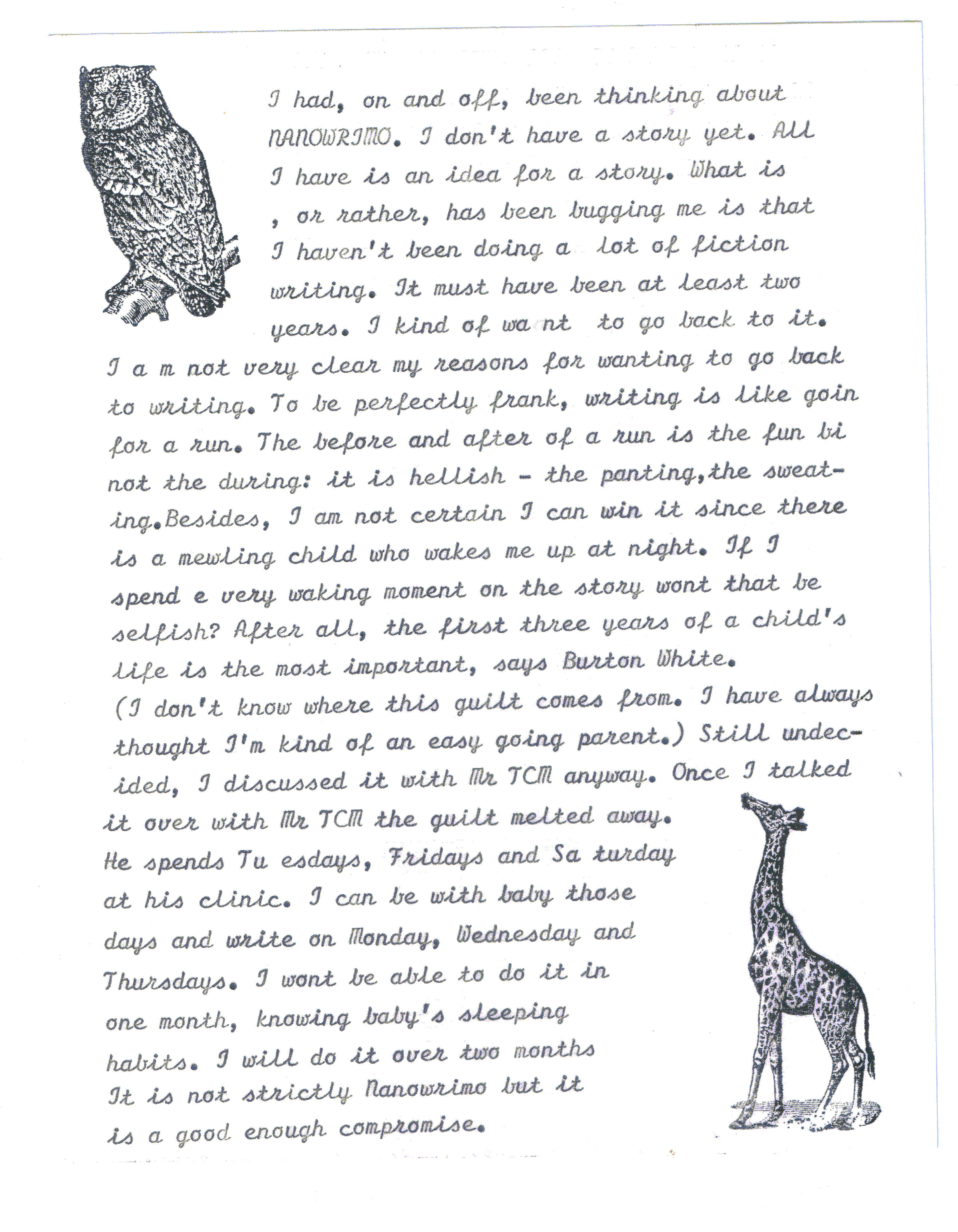
P.S: I got these stamps from Pictorial Websters. The owlet and the deer doesn’t look so good. The rest seem fine.

I was looking for Singaporean mothers who practice baby led weaning when I came across a blog Opinionation, written by Grace. I have been seeking parenting books to learn the right way of parenting. Even though I haven’t properly learnt the skills taught in How to Talk So Kids Will Listen & Listen So Kids Will Talk’, her strong reccomendation of Burton White interests me. I think I will get on Kindle.

P.S: Will try a better quality scan when I next do it
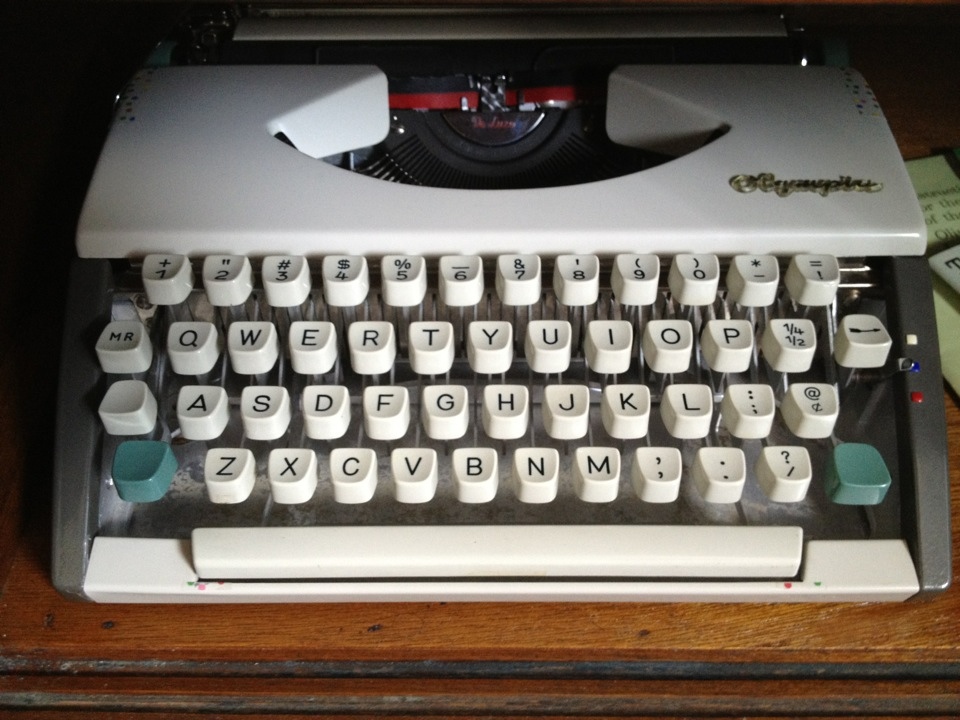
It looks like this (seller’s photo)
There’s a theory about the specific suckling technique the breast engenders, which develops the muscles needed for speech. Williams becomes convinced – and has convinced me – that breasts evolved as a driver of female and infant survival, and men’s obsession with them arrived not “in lockstep”, but some time later. “Perhaps, all along, the breasts were calling the shots,” she concludes.
…
The composition of the breast makes …[breastmilk]… a magnet for environmental toxins, so they “carry the burden of the mistakes we have made in our stewardship of the planet”.
This is from a book review on guardian. Interesting but not something that will be in my read stack anytime soon.
A child at 4 months, I imagine, is a creature who exist to poop and feed. I was disabused of this notion when the little boy A. fussed when I tried to train him to take away his toy. I was getting the hang of having a person for whom things have to be done. I’m fairly good at figuring out what A is yelling about. I am not ready to manage his ego. It was disturbing that this came so early.
Troubled, I turned to Berkeley Parents Network for some parenting books recommendation.
How to Talk So Kids Will Listen & Listen So Kids Will Talk – Adele Faber, Elaine Mazlish Unconditional Parenting – Alfie Kohn
What’s Going on in There? – Lise Eliot
Raising Our Children, Raising Ourselves – Naomi Aldort.
The Idle Parent – Tom Hodgkinson
Of these books I read, the worst was Alfie Kohn. He is so bad I stopped reading the first chapter of ‘Raising Our Children, Raising Ourselves’ because it sounds like the same advice. Alfie Kohn is so bad he is unbelievable. It is too bad this is an e-book I bought. I don’t have the satisfaction of slamming the book and aiming it at the bin down my living room. This guy is basically writing a long essay about his own ideas of parenting. He says that kids being disciplined or being praised will be taught that parents love is conditional on them pleasing their parents. To raise kids who are self motivated, and who believe in their own worth, he thinks parents should show unconditional love regardless of the child’s behaviour and achievement. So basically, if the kid is annoying just because he wants to, you suck it up, smile and go on with your own things because you are showing unconditional love. This is wrong. Society rewards cooperative behaviour. I am not about to bring up a child who thinks the world will not punish him for undesirable behaviour. Intense competition, intense desire for the child to obey affects any one – we don’t enjoy such environments at work. I can’t imagine why someone will treat their child in the same way at home. That I agree. What he advocate seem to be creating a false reality at home. Resources are limited: we reward good/cooperative behaviour and punish bad behaviour. No one will take time to reason anyone out of bad behaviour. To avoid guiding a young child, allowing the child growing without learning the skills to deal with the world he/she inhibits is my idea of bad parenting. By learning to obey, we learn how to live with another in a cooperative manner. Lots of people think that obedience is easy. It is actually very hard. Obeying requires high exposure to authority and frequent reminders to control one’s behaviour. Being individualistic is easy. All that is needed is to limit one’s exposure with society and popular media. Attention is diverted to one’s own hobbies and interests. After a time, one’s outlook naturally diverges from everyone else. Humans go primal without much urging. I’m up to the chapter where he says competition is bad because to feel good, someone else has to lose. What he doesn’t get is that losing is as important as winning in a competition. It trains a person to self sooth, which is an important ability. The world is always unfair. Not giving the child opportunity to learn to overcome obstacles and continue to extert effort towards one’s goals is bad parenting. The adult world is much less kind. While we want to be sensitive to our child’s feelings, we need to guide him so that he has the skills to be a productive, cooperative member of society. I found ‘How to Talk So Kids Will Listen & Listen So Kids Will Talk’ very useful and practical. I felt that the techniques were useful while communicating with adults. I enjoy ‘What’s Going on in There?’ because, well, I enjoy brain studies. I enjoy the Idle Parent for its humour and writing style. While I agree with its principle, I didn’t find it as practical, especially when it advocates lots of running wildly in the park, or throwing a ball in the lawn. That is difficult, considering, Singapore is warm (no one will want to run around except for old people trying to be healthy) and I do not have a lawn.
 headbirth.com